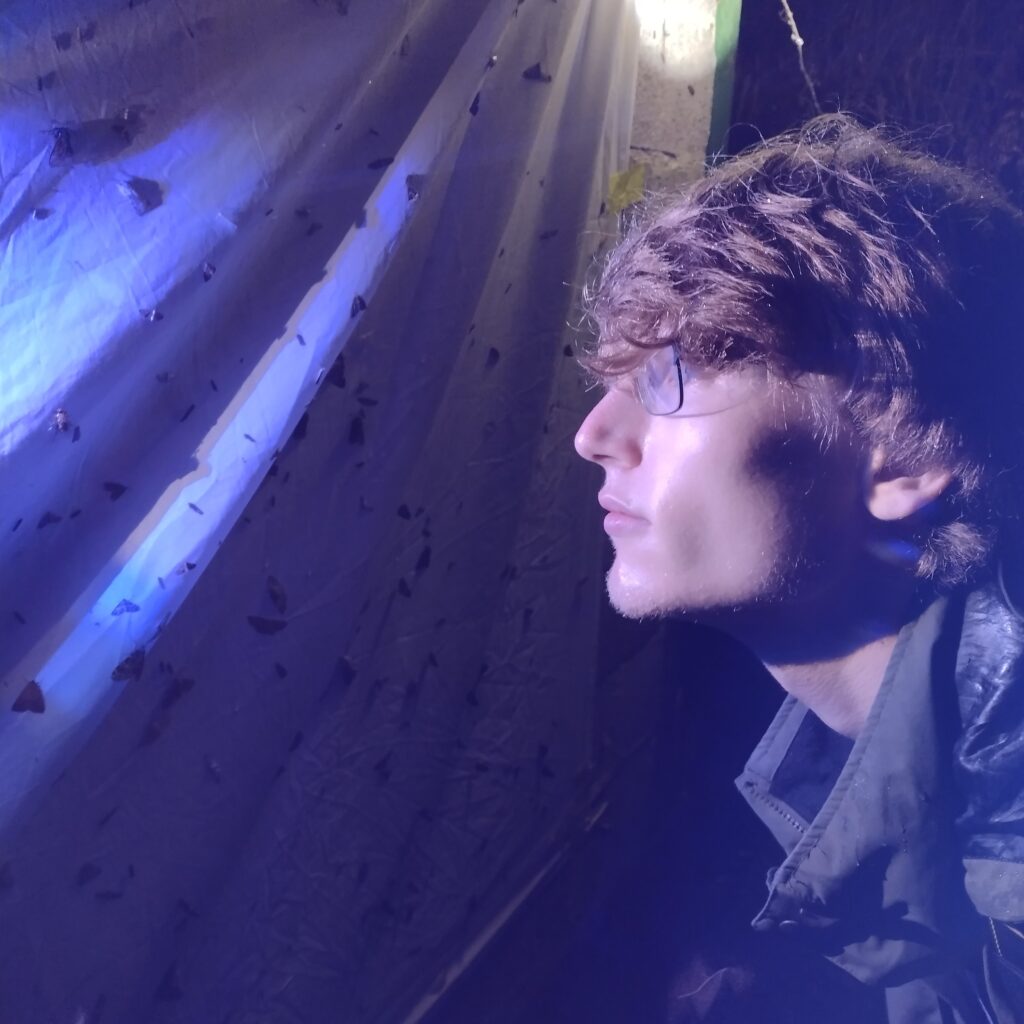
PhD: Reclaiming the night sky for moths: what drives the flight-to-light response and how can this be mitigated? Location: Rothamsted Research Email: Elliott.Cornelius@Rothamsted.ac.uk My PhD project has me based at Rothamsted, where my research will investigate the drivers of phototactic behaviour in moths. To achieve this, I will first utilise an electroretinogram to identify the […]
Read More
PhD: The genomic and adaptive consequences of extreme, human-mediated population decline Location: Bangor University Email: osub4a@bangor.ac.uk Linkedin: https://www.linkedin.com/in/charlie-gregory-714a63206/ I completed a BSc in Marine Biology at Bangor University and a Master’s by Research (MRes) programme investigating whether chronobiology can augment sustainable aquaculture nutrition and fish health. Specifically, the research allowed me to utilise molecular, biostatistics, and […]
Read More
PhD: Delivering Ecoacoustic Net Gain in the UK Location: Lancaster University Email: m.a.clark@lancaster.ac.uk LinkedIn: https://www.linkedin.com/in/matthew-a-clark-4a517b1aa/ I graduated from the University of Bristol with a BSc in Zoology in 2015. I then worked, volunteered, and studied at several conservation NGOs and research institutes in Latin America and Europe, before returning to the UK and working in […]
Read More
PhD: Anthropogenic change and disease susceptibility in poison frogs: identifying links with diet, skin alkaloids, and the microbiome Location: Bangor University University mail: lbh23kyx@bangor.ac.uk Twitter: @AlbertoOrta19 I completed my undergraduate degree in Biology at the Autonomous University of the State of Morelos (UAEM) in Cuernavaca, Mexico where I studied the loss of sex chromosomes in […]
Read More
Location: Lancaster University Email: pearce@lancaster.ac.uk I’ve taken the scenic route to starting my PhD, having worked in GIS, policy and catchment management in the UK and New Zealand. My work has always been related to sustainable agriculture, and I’m broadly interested in how we can ensure the long-term sustainability of food production while protecting the […]
Read More
Project title: Volcanic fertilisation of tropical forest biomes Location: British Geological Survey – Keyworth Email: cbengt1@bgs.ac.uk I completed my Master’s (MRes) degree in Biological Science at Birkbeck, University of London, where I studied DNA extraction in archaeological animal bones. The project involved optimising the DNA extraction and purification protocol for ancient DNA extracted from animal […]
Read More
PhD: How do coral energy strategies influence their survival? Location: School of Ocean Sciences, Bangor Email: f.amir@bangor.ac.uk Social media contact – BlueSky: @farutholhi.bsky.social After completing my BA in Biology at NYU, I focused on the marine environment by pursing an MSc in Marine Environmental Protection at Bangor University. Since graduating in 2018, I have worked […]
Read More
Project: Bird life in the Anthropocene: understanding convergent adaptation to urbanisation Location: University of Nottingham Email: Marina.MartinMaroto@nottingham.ac.uk Linkedin: https://www.linkedin.com/public-profile/settings?lipi=urn%3Ali%3Apage%3Ad_flagship3_profile_self_edit_contact-info%3BDFFmYPMEQCaoXEZBhUYzXg%3D%3D My research focuses on how anthropogenic change influences the evolution of bird species. Urbanisation has significant impacts on global biodiversity, altering the habitats, behaviours, and phenotypes of countless species. Therefore, it is crucial to understand how […]
Read More
PhD: Establishing the relative importance of a rainforest microcosm in oil palm plantations Location: Bangor Email: tld23fnl@bangor.ac.uk LinkedIn https://www.linkedin.com/in/matilda-edwards/ With my move to Bangor, I am looking forward to researching conservation biology while making the most of the opportunities to get outside and be active. I enjoy walking, hiking and cycling in the mountains, with a […]
Read More
PhD: What’s for dinner? Oceanographic drivers of Manx shearwater chick provisioning and growth Location: Bangor Email: Lrv23ngq@bangor.ac.uk Twitter: @laurenevans217 Bangor University Research Profile webpage: https://www.bangor.ac.uk/research-students/ocean-sciences/lauren-evans-644067/en I studied Ecology at the University of Edinburgh where my honours project focused on the association between European Storm Petrel body mass and a declining principal food source. After my undergraduate degree, […]
Read More